There has been little time to write and scarce Internet in
the last few very busy days. I
cannot possibly relate all that we have seen and done but here are a few of the
most memorable.
The trip from Delhi, southwest to the small city of Mandawa,
took about eight hours to cover three hundred kilometers. We started on freeways, then dual track
roads, and finally single-track (give way) country roads. We went through countless towns and
villages; and had front row seats to see rural village life. At no time was anyone board.

The crazy freeway driving was the same as previously
described but with additional herds of roaming cattle and an occasional monkey
to contend with. Assigned lanes
were unused and drivers stopped haphazardly at any time. Trucks and buses carried people sitting
cross-legged on the roof with nothing to hold on to, at freeway speeds.
The dual tracks were also a constant adventure. Passing is a whenever, wherever driver
choice activity. Vehicles chose to
pass simply by honking the horn and going for it. It is a constant game of chicken where bigger is usually
rewarded. Three vehicles in two
lanes is the norm with the loser hitting the shoulder. Passing on blind corners is also a given
and as a result, the roads are littered with the vehicle remains. Motorcycles (carrying anywhere from one
to four people) are treated no better than insects. Cars traveling in both directions combine to force cyclists
off the road. Horn honking is
constant. Our driver told us
Indian drivers must replace their horns every three months.
 |
After a while headon no longer scared us. |
 |
Stuff Happens |
 |
Every Vehicle is a Bus. |
 |
Cattle Rule - especially when you meet a Bull in an Alley. |
 |
Toll Booths are every few miles |
The final section was single track. Our driver had won most one on one battles to that point but this time he chose to hit the ditch at the very last second. The vehicle was a comparable size but much newer. We think he lost in deference to someone he perceived to be important.
The first thing we noticed on the drive is the huge number
of roaming cattle. Cattle are
sacred and communities provide them food and water. All cattle have some value as they eat the endless streams
of garbage found everywhere. Families
for milk keep females but males simply take up residence anywhere they want. Cow patties are used to heat homes in
the winters. Stacks of cow patties
can be seen everywhere drying in the sun. We are creating a list of the “top ten least favorite jobs”
in India and cow patty stacker is right up there with “patty wacker” and “patty
porter”.

 |
Cow Patty Resource Center |
Our
drive traversed different kinds of countryside. It is spring in northern
India and the trees were full of the new green that comes with first growth. It took us a few hours
to see the trees through the smog after leaving Delhi but the blue sky
eventually showed itself. Mandawa is in a desert.
 |
Loads of Gound Acacia Tree - Camel Food |

 |
Rural Indian Children Hung Up to Dry After Bath |
 |
Harvested Acacia Branches |


 |
Camels Do All the Work |
The depth of the poverty became more evident the further we traveled into the countryside. You have to steel you emotions in India. Your heart goes out to those that have so little. You want to give constantly but realize it would make little difference. Those having travelled in rural Mexico would see similarities in the poverty but India’ is a little deeper and on a much larger scale.
 |
Beggars Being Shooed Away from Restaurant |
In contrast to the poverty there are also signs of the
emerging economy. We saw new
construction including railways, roads, subdivision and new business centers,
in many of the small villages.
As we entered the state of Rajasthan our focus turned to competing
for the best “working camel” photo.
Between four cameras we got a lot of heads, midsections, and butts but
no complete shots.
Mandawa was a very pleasant surprise. It is a small rural town of only 25,000
people and very few tourists.
Mandawa was once a thriving town that served as a stopover along the
Spice/silk route from China to Europe.
When the British left in 1947 many of the town’s business families also left
the village to take up new businesses and residences in the cities vacated by
the Brits.

 |
Our Mandawa Hotel Haveli - Open to the Sky |
We took a walking tour of he villages many frescos painted Havelis (ornate courtyards in Hindi). They are still owned by the city folks but have fallen into disrepair. Our hotel, a former family mansion built in the 1800’s, probably had the best frescos in the village. We dined on the roof with a canopy of the desert stars. Deborah entertained us by dancing with the locals.


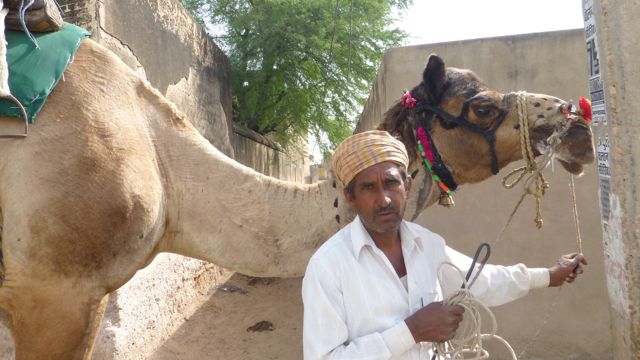
The main reasons for our visit to Mandawa were the
camels. We mounted up in a small
alley behind the hotel. This was a
very basic operation and there were no stands to allow easy mounting. Stan and Doreen went first and showed
us the way. The camel dropped to
its knees as the rider(s) mounted and places his/her feet in the stirrups. After everyone is on, the camel whisperer
gives the command to rise. It is a
long way to the ground when a camel rises to its full height. The others followed and mounted without
incident. Deborah and I were
last. I knew something was up when
the man in charge looked at the two of us and waved off the next camel in
line. He said something about needing
a stronger animal. Deborah has
been enjoying her butter chicken but I don’t think she was the problem. After a few minutes of waiting a rather
large, unhappy looking camel emerged from the paddock. He dropped to his knees on command and
I attempted to mount. After swinging
my leg part way across and before Deborah had a chance, he suddenly rose
up. Deborah jumped out of the way
as his legs splayed out behind him.
I thought I was going to be launched over a nearby wall and got skin
burn on my legs from squeezing so hard.
Eventually he settled down but he wasn’t happy being put to work.




 |
| Talking to Mum on Cell |

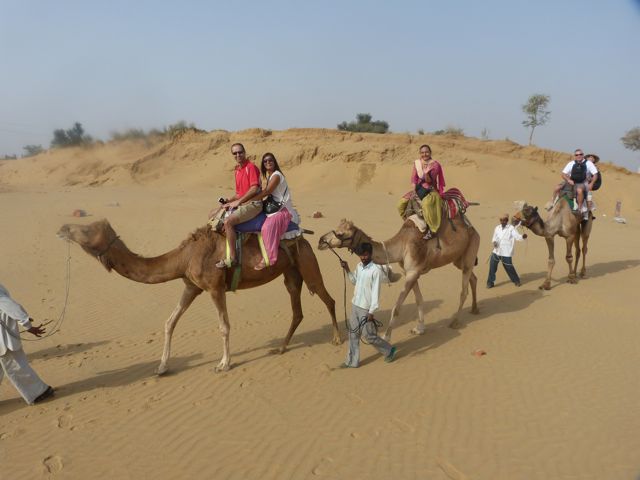
The ride took about an hour as we meandered out of town on
to the sand desert. We got the
hang of rolling with the camel and enjoyed the ride. I phoned my mother back in Abbotsford when we hit the
sand. Our activity was about as
ancient as it gets in this area and I thought cell phoning across the world would
be a great contrast. We had
further problems at the end of the ride as the camel chose to drop down for
dismount only to jump back up as we were letting go. Scary but we managed successfully a second time.
After a good nights sleep we traveled about 180 kms to
Chomu. More interesting scenery
and more sights of families making do with what they have. Every village had a vacant patch of
dirt filled with children playing cricket. Cricket is the most popular sport in India.
We stayed in the walled Chomu Palace Hotel. It is a beautiful 58-room hotel that
had its beginnings as a grand residence but like other smaller cities, the
family moved away and it became a factory until recent times and its conversion
to a hotel. Unfortunately for the
owners there were only two rooms rented the night we were there. For the most part of our evening meal
in the grand dinning room, staff outnumbered our party of seven. The meal was superb and we finished
with our usual Masala Chai tea.


We travelled for about an hour before reaching our next destination,
the Amber Fort. Mounted on the
hill just outside of Jaipur it was once home to the royal family that ruled the
region. We hired a guide and had a
very interesting tour that gave us a good idea of what ideal life would have
been like 400 years ago. The King
had 12 wives and 97 concubines so there were a lot of rooms to go through. It was in the high twenties outside but
very cool and comfortable outside.
The architecture was a fusion of Hindu and Muslim styles. The King who built the fort was a
strategist and wanted to appeal to the majority. The region did not produce wealth. Soldiering and warring was the purpose of the area.
 |
Amber Fort |
 |
Hall Of Mirrors |
 |
Royal Bath Tub |
While our mission was to see the Amber Fort, our primary objective
was to ride the elephants from the base to the top of the mountain. This time there was a tower to mount. Two at time we rode the narrow stone
pathway to the top. Many pictures
were taken with both Stan and Jinder donning Maharaja turbans for the duration
of the stay.
 |
Elephant Loading Zone |


 |
Picture Courtesy of Doreen Photography Ltd. |

After the elephants we toured jewelry manufacture plant
specialized in precious and semi precious stones of India. All the ladies participated and India
is now down a considerable number of rubies and sapphires. The men signed a lot of autographs.
 |
The Shop Owner Can Now Retire |
 |
The Boys are Tired from Signing Visa Autographs |
We ended the night in Jaipur with a dinner at a neighborhood
restaurant. Until you have been
there you cannot really imagine a night street scene. There is dust everywhere and walking is dangerous on broken sidewalks
and roads. The smog is intense in
the city and the honking never stops.
These are not negatives; we came to India to experience something
completely different. Typical of
most things in India, you find a gem or great experience where you least expect
it. As we waited to go in to the
restaurant, Sting walked out. He
and his wife posed for a few pictures and we were placed at the table his party
just vacated. The fusion meal of
Chinese, Italian and Indian was fabulous.
On the way home we got another unexpected thrill. We were about 5 km from the hotel and
our party of six jumped into two tuk tuks. Our driver looked to be in his late 80’s with a maniacal
smile, long grey hair and beard.
His partner took the lead on the relatively quiet streets but seconds
later he cranked the throttle and flew blew past Stan, Doreen and Jinder with
high speed. Jinder was not about
to be beaten so a few placed words had his man at full speed. The two tuk tuks raced through the dark
streets. Kal, Deborah and I had to
hang on with all our might. I am convinced
our driver was mostly blind because he nearly hit two vehicles as well as drove
us directly into oncoming traffic.
Like the Red Sea they magically parted and we went shooting through the
gap. We separated at one point as
both teams raced down alleys to get back to the hotel. We were convinced our guy was a former Afghani
terrorist because while Jinder team got to the hotel first, out guy drove right
through security and aimed for the door first.
Deborah reminded me we should say something about the
food. We are eating Indian most of
the time. Breakfasts are similar
to home with cereal, yogurt, fresh fruit, omelets, and Indian parantha (stuffed
pancakes) and sholay (chickpeas). Without
a doubt I am gaining weight and it has only been one week. No Delhi belly so far.
We are also learning a little Hindi. At the end of most dinners we order coffee
or masala chai. We often
heard Jinder telling the waiter, “coffee shitty”. We were a little taken aback and a little embarrassed when
we thought he was complaining on behalf of the coffee drinkers. Someone finally asked Jinder, “Why are you
complaining about the coffee before we even get it?” It turns out that in Hindi, “kofi shitty” means, “very
quickly”. The coffee was actually
very good.
Off to Agra and the Taj Mahal.
Ps. we saw a little Indian justice on the
freeway today. We came upon a
large transport stopped and blocking the road. As we inched by we saw two young men run across the front of
our bus. They had just got out of
a new SUV that had been hit by the truck.
We looked across the freeway and saw the two young men join some others
and they appeared to be chasing two more.
Our driver surmised that the truck drivers had rear ended the SUV and ran
from the scene. He suspected that
if they could make the long grass they could hide from the pursuing accident
victims. If they were undetected
they would likely wait to see if the SUV left. If the SUV didn’t leave they would probably abandon the
truck and walk to a different state and get a new job. When we asked what would happen if they
caught him, he simply shrugged his shoulders and said, “they will beat
him”. We don’t know what happened
next.


