Saturday, 16 March 2013

The Golden Temple


We were up early today and made our way to Amritsar via the Golden Temple.  The Golden Temple is the spiritual home of the Sikh religion and is a pilgrimage sight for all Sikhs that can travel.  Our hosts rented a bus for our convenience and off we went with our new family for the two hour drive.

Deborah and Another New Bodyguard


On the Bus to the Golden Temple


The Temple is located within the city of Amritsar but vehicles are not allowed to drive all the way to the entrance.  We parked the bus, purchased our head scarves, and hopped on rickshaws for the final 300 meters.  Stan and Doreen were in the front while Deborah and I hung off the back. 

The Ladies Were Ready


We checked our shoes and walked the remaining 100 meters in bare feet.  Some might be squeamish about walking barefoot in India so I won’t speak about the experience of using the washroom.  Fortunately almost everywhere we went involved dipping our feet in water.

Sikhs bathe in the pure waters of the Temple pond to cleanse their souls and to bring them good fortune.  We lingered by the side and took pictures.

We Were Quite the Curiosity to Many Especially Children


Once Inside the Gate - The Line Was Long to the Temple


The lineup for the actual Golden Temple was an approximate 2 to 3 hour wait.  Jinder's cousin Natha talked to a guy who talked to a guy and soon Jinder, Stan and I were sitting in an office in front of some kind of big official.  He didn’t waste a moment being friendly while Jinder pleaded our case (we had a 3:50 flight to Mumbai).  He questioned us about where we lived and then took an inordinate amount of think time before dismissing us with a wave of his hand.  Soon we were guided through a reverse process, entering through the exit.  Our guide led us past the long line of hot, patient, holy, waiting worshippers.  Guilt and worries of entitlement crossed our minds as we walked purposefully past the long line directly to the entrance.  When we crossed the threshold of the inner temple Stan and I both mistakenly stepped on the threshold.  Bad enough we bypassed the line but we stepped where everyone else touched his or her foreheads before entering.  Stan got a gentle slap from a nearby patron.

We finished the visit by sharing food in the dinning hall.  The Temple feeds thousands, twenty-four hours a day, seven days a week.  There is no reason anyone in the area should ever be hungry.  Every food preparer is a volunteer.  Everyone picks up a food tray, files in, and takes a seat on the floor, in long straight lines across the room.  Servers come along and ladle four different types of food onto your tray.  We promised ourselves we would not take part in eating due to the fact the trays are rinsed in local tap water but not to eat would have been disrespectful.


Volunteers Peeling Vegetables for the Meals


We finished dinner and rejoined at the bus.  It was a short ride to the airport and we made our good-byes.  There were promises to return and expressed hope for a chance to return the generosity.

Friday, 15 March 2013

Jullundher - A day in the Villages


Today was dedicated to meeting Jinder’s extended family and visiting his ancestral villages.  Our hosts were beyond welcoming.  Three vehicles and various cousins picked us up from our hotel and dedicated their day to us. 

We left the city and drove through various farming communities to Jinder’s mum’s village, Pajodatta and then his dad’s, Burrajatta.  Compared to the southern states we visited, Punjab appears to be more modern, greener, and much cleaner.  Clearly, Punjab is the “bread basket” of India.  There are also many less cattle roaming the area.  While Sikhs do not eat meat, cattle are not held sacred like Hindus.  The males are herded into communal lands, fed and watered, but not allowed to roam.  The cows are kept for milking.

Cycling In India


Exotic Birds Everywhere.


More Modern - But BC Hydro May Say Otherwise.


Motorcycle Transport


Actually Four - Babe in Arms.


Road Work Crew Member - All By Hand


I believe we experienced a snapshot of what life is like in India for the middle class.  Not to say it is easy but if a person owns land, is a smart businessman, and is prepared to work hard, they can have a very good life.  Jinder’s family has owned land in this area for over 200 years.  The land never rests.  Many farmers sow wheat in October, harvest in April, sow rice in April, and harvest in October.  Others grow sugarcane year around.  In both cases they plant poplar trees amongst the crops.  Poplars mature in 5 to 6 years and are used for making plywood and cricket bats, to name a few.

Poplar Trees with Wheat Crop Below

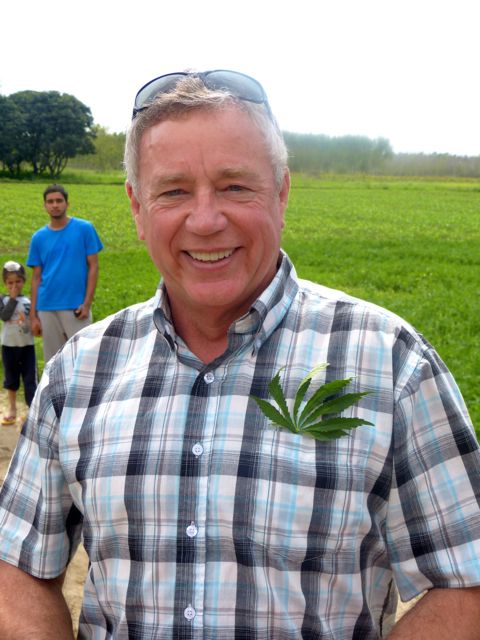
Marijuana grows everywhere.  If a crop is not in the ground, marijuana takes over.  The ditches are full.  It is not used for any purpose in this area.  Livestock and birds will not eat it but there are stories of non-Indian young people relocating to the area for months at a time to indulge themselves.  Food is cheap and weed is plentiful.

Marijuana, Wheat, Poplar


Marijuana, Cow patties, Stan


We arrived in Pajodatta and met more family and village neighbors.  Jinder’s cousin, Natha farms the area and keeps a country home as needed but spends most of his time in residence in Jullundher.  Natha is a successful farmer but also gives back to the village as a patron, supporting both the school and temple.

We walked to the village school established by Natha’s grandfather seventy years ago and visited the classrooms.  School was in session and our visit likely ruined the learning environment for the rest of the day.  The kids were excited and eager to show us their work.  The principal proudly had the best reader in the school read out loud in English for us.  The school housed preschool-aged kids up to children around eleven.  The curriculum is focused on Punjabi, Hindi, English languages and Mathematics.

Preschoolers and Their Lunch Pail


Boys Off To School


Three Principals Disturbing Class


Principal, George, Natha (Patron)


Staff and Preschoolers at Lunch


Our visit to Burrajatta was an emotional one for Jinder.  Much of his first seven years of life were spent in Burrajatta.  When we arrived in the village he began to reminisce about the yard he played in, the tree he played under, the lanes he walked and the house he slept in.  The village is very similar to when he left it.  As we stood on the roof he allowed himself think about what life might have been like had his father not made the decision to move. 

Jinder's Childhood Yard


Entrance to His House


His Courtyard Where He Ate and Played


 The house is still in his family and an outbuilding his great grandfather built still stands.  Their property is now let to local growers.  As we walked out to view his fields we passed a crew harvesting sugarcane and stopped to have a taste.  Workers put in long days for the equivalent of about $2.60 Canadian a day and three meals.

Girls In The Mustard Field


Off To The Fields


Sugarcane Harvest


Stan Could Not Resist Tryout As A Patty Packer


We returned to Pajodatta and Sukhvinder, Natha’s wife, and the ladies had our lunch prepared.  We had the most fabulous Indian meal and the fresh homegrown vegetables made it the best meal so far.

Everyday Cooking In The Village


Preparing Saug (Spinach Dish)


We returned to the hotel and some of us had naps while the others were out shopping the bazaar.  Deborah is now in the lead in the Pashmina count but Doreen has not capitulated as of yet.

We went to a restaurant/entertainment center called the Haveli.  We entered into a fully replicated farming village complete with life-sized recreations of every aspect of village life.  The meal was a traditional vegetarian meal representing Punjab of old.  We ate and drank some things we were unfamiliar with but so far so good.  Family (yes including us) pictures were taken and good nights were made with hugs all around.

Our New Jullundher Family

I experienced a truly senior moment when one of the young men shook my hand and then quickly bent and touched one hand to both my knees.  Kal explained later that that is a sign of respect for ones elders.  I guess the grey hair is proving some worth.

Off to Amritsar and the Golden Temple tomorrow.


Wednesday, 13 March 2013

Jaipur to Agra to Delhi to Jullunder


We were up bright and early for our trip to Agra and the Taj Mahal.  We made our first stop at a local carpet maker.  The weaver was the latest family member to continue a 160-year weaving tradition. 

Deborah's New Bodyguard - Leaving Jaipur 


Our second stop was the World Heritage site, Fatehpur Sikri Moghal Family mausoleum.  It is a huge monumental fort-like structure that rises several hundred feet above the plain.  The mausoleum was built by Moghal Akbar “One and a Quarter” in 1569 and served as capital of the Moghal empire from 1571 to 1585. He was one of the many royal heads of India during the 300-year rule by Mongolia.  The monument was meant to pay respect to a fusion of Islam, Hinduism and Christianity, and gain favor with the locals.  People travel great distances to tie special strings and make wishes at the holy place.  We made a donation and tied our strings.  Tradition states you cannot speak about your wishes but if they come true you must return and untie the string, or as an alternative, celebrate by giving chocolate and ice cream to children.  We will see…


Our last stop was Agra and the Taj Mahal.  We booked into the hotel and hired a local tourist guide.  The Taj Mahal translates into “royal palace”.  It is another World Heritage site and was built by a Moghal in 1648 to honor his wife (who bore him 9 daughters and more importantly, 4 sons.)  Unfortunately she died before it was complete.  Her husband didn’t fare much better.  His third son killed his two older brothers and imprisoned his father for spending too much money on building the palace, before assuming the throne.


The sight is best seen in the early morning or at sunset.  At sunrise the white marble appears pink and at sunset, amber.  We bought our “foreigner” $15 ticket (Indian’s pay 40 cents) and jumped the long queue. Even though we had all seen pictures of the Taj Mahal, we followed our guide’s instruction and averted our eyes until we were about 200 meters from the “royal palace”.  On his count we all looked up and there it was.  For the first few seconds it was surreal.  It looked more magical and magnificent than any of us had imagined.  We wandered the gardens and gazed at the structure from different perspectives.  Inside is much less impressive than out.  The palace was never actually used for anything and the British stripped any gold long ago.  The kindly British replaced all the gold pinnacles with brass.  The gold pinnacles reside safely in England for all to see (except poor Indians).

Our Agra Hotel


Travelling Like a Royal on a Beer Budget in India

We had a leisurely sleep in the morning and a little pool time before completing our last leg of the “Golden Triangle” returning to Delhi.  We made the three-hour journey on a brand new freeway.   Essentially we were the only vehicle present during our trip.  The road toll was 350 rupees compared to 40 to 60 rupees previously.  It is a beautiful road but only tourists and rich Indians can afford to use it. 

Common Sight - Sometimes Four

And Our Kids Thought Riding the Bus was Tough

This Guy Kept Me Inside the Bus

Freeway Riding For Those Without Motorcycles 

We arrived at the Delhi railroad station one hour before our departure to Jullundur (Jalandher) in Punjab.  Jinder had prepared us for the chaos of Delhi Central and we had a strategic plan.  We were to hang on to our own luggage and either carry them or negotiate a package deal with one porter.  We had a price in mind and knew they would ask many times more.  Most importantly we were to stick together and leave no valuables within easy reach.

As soon as our van drove into the parking lot we were “attacked” by a passel of porters.  Three or four leapt up onto the bus bumper before we could stop.  Our driver Anand decided to make a hasty exit and circled the block once more.  We lost three off the back almost immediately but one persistent porter hung on for about a block.  We found a different, quieter entrance and negotiated a price with a new man.  We made our way to the platform, regrouped and planned the next steps.  We had an assigned car and seats but we knew there would be more luggage than space.  We paid the porter to stay with us and pack the big cases onto the train.  The women were to advance with the daypacks and secure luggage space.  The men would follow with the big cases.  When the train arrived we went to work.  There was a mass rush to the only narrow entry.  The women sped ahead and I followed laying down my suitcase in front of some older folks to create a barrier.  The women were on and our man was next.  Our wily porter slipped through.  Stan set a pick for Jinder and soon we were all on.  When we arrived at the seats our porter manhandled the luggage into the racks and we were set.


The ride itself was outstanding.  A first class ticket for the five hour trip cost $20.  We were given bottles of water and soft drinks as soon as we left the station.  A tray of sweet Indian delicacies and tea followed shortly.  An hour later we had tomato soup and bread sticks.  At the three and a half hour mark we had a full mean of dal, rotis, rice, vegetable paneer, chickpeas, pickles and yogurt.  A desert of ice cream followed to finish the meal.


We arrived in Jullundur at 9:30 pm and were met by members of Jinder’s family.  Our bags were whisked away and we were in our hotel soon after.

Tomorrow calls for visits to local villages and a family lunch.