Monday, 18 March 2013

A Day in Mumbai


Mumbai is a much different city than we had encountered previously.  We walked out of the airport at 9:30 at night, into a wall of hot, thick, humid air.  We made contact with our driver and made the 45-minute drive to our hotel in the old British colonial part of the city.  We dropped our bags in our rooms, walked the sea wall and enjoyed a pizza and beer by the water.  As we relaxed it hit us that here we were looking out at the Arabian Sea.  There was something magical about the whole experience.

We All Had Water View Rooms


 Our two nights and a day barely scratched the surface of this historic city.  It is one of the most populous regions in the world with the city itself numbering 20 million plus.  It is also India economic capital and is the wealthiest in all of India.  We chose to stay in the colonial area and much of the architecture could have been pulled from urban 19-century England.  It is easy to imagine what it was like before the British left in 1947 as we strolled by the parks, garden and cricket matches.


Cricket On The Common


Of Course the British Wouldn't Allow Honking

Our day in Mumbai started on a somber note as we received word from back home that a friend passed away suddenly just weeks past his fiftieth birthday.  Such events remind us about the tenuous nature of life and how we need to take our opportunities as they come.

Kal and Doreen were our guides for the morning as we embarked on a walking tour of the Colonial District with map in hand.  First stop was a street vendor and a purchase.  Stan and Doreen negotiated a fair price and the vendor began to wrap the items.  As he began to wrap there was a distraction.  In a previous post I mentioned the large number of birds in India and that fact came back to haunt me.  As I stood observing the purchase not one but three bird bombs from above hit me.  I jump aside when hit by the first one on the shoulder, only to be hit by another on the head and finally, took a last hit in the chest.  Stan and Doreen told me it means good luck to be shit on but I think they were just pleased it wasn’t them.  It turned out that the final hit was not on me.  As the group was distracted, the vendor dummy wrapped one of the purchased items and substituted something he probably couldn’t sell.  We never new until we were back at the hotel.

Vendor Helping Me Clean the Bird Shit (and Smiling)


Further along the walk a man selling balloons approached us.  He held an inflated balloon two-thirds the size of a man.  Stan, Jinder and Deborah all bought a package after a full negotiation.  He played hardball but the savvy travelers wore him down.  The purchase was made and off we went.  We then met a man who appeared to be selling the same balloons, complete with the two-thirds human size inflated sample, except the balloon in the package were four times the size of the ones we purchased.  Six intelligent travelers had been had.  We saw the big balloon and bought a package of small ones.  Jinder ran back to the original location but he was gone.  I am sure he was smiling at the hard bargaining tourists.

Purchasing over we turned to touring.  The streets are full of grand buildings and the Gateway To India stands at the waters edge.  Adjacent to the gate is the Taj Hotel.  This is the most famous hotel in India and has hosted heads of state and entertainment stars from around the world.  It is also the hotel, along with our own Trident Hotel, Pakistani terrorists targeted back in 2008 that resulted in deaths and fire to the Taj.  The sole-attacking Pakistani-state survivor was tried and executed last November.  Tensions still run high between the two countries and just yesterday, the international Cricket Test matches between the two countries were cancelled.

Gateway to India


Members of the Dairy Association in town for Conference


The Taj

We enjoyed tea in the Taj lounge and continued our walk.

Pinkies Up


After much shopping and standing around we arrived at the famous Leopold CafĂ©.  The Leopold appears in many movies centered in Bombay/Mumbai and is referenced in many fictional stories written in India.  It too was a target of the Pakistani terrorists and still has bullet holes to prove it.  Great food and well worth the visit.

Lunch at the Leopold


Our one-day in Mumbai ended with a dinner in celebration of my birthday.  Bollywood was our first choice until we found out is was a two to three-hour drive and that was not even in the outskirts of the city.  We also discovered you cannot dine with open toed shoes in many Mumbai restaurants.  At the end of the day we finally found a place in our neighborhood and I enjoyed my first Bombay Gin and Tonic, courtesy of Stan.

I think those arms spell a Sixty-One


Saturday, 16 March 2013

The Golden Temple


We were up early today and made our way to Amritsar via the Golden Temple.  The Golden Temple is the spiritual home of the Sikh religion and is a pilgrimage sight for all Sikhs that can travel.  Our hosts rented a bus for our convenience and off we went with our new family for the two hour drive.

Deborah and Another New Bodyguard


On the Bus to the Golden Temple


The Temple is located within the city of Amritsar but vehicles are not allowed to drive all the way to the entrance.  We parked the bus, purchased our head scarves, and hopped on rickshaws for the final 300 meters.  Stan and Doreen were in the front while Deborah and I hung off the back. 

The Ladies Were Ready


We checked our shoes and walked the remaining 100 meters in bare feet.  Some might be squeamish about walking barefoot in India so I won’t speak about the experience of using the washroom.  Fortunately almost everywhere we went involved dipping our feet in water.

Sikhs bathe in the pure waters of the Temple pond to cleanse their souls and to bring them good fortune.  We lingered by the side and took pictures.

We Were Quite the Curiosity to Many Especially Children


Once Inside the Gate - The Line Was Long to the Temple


The lineup for the actual Golden Temple was an approximate 2 to 3 hour wait.  Jinder's cousin Natha talked to a guy who talked to a guy and soon Jinder, Stan and I were sitting in an office in front of some kind of big official.  He didn’t waste a moment being friendly while Jinder pleaded our case (we had a 3:50 flight to Mumbai).  He questioned us about where we lived and then took an inordinate amount of think time before dismissing us with a wave of his hand.  Soon we were guided through a reverse process, entering through the exit.  Our guide led us past the long line of hot, patient, holy, waiting worshippers.  Guilt and worries of entitlement crossed our minds as we walked purposefully past the long line directly to the entrance.  When we crossed the threshold of the inner temple Stan and I both mistakenly stepped on the threshold.  Bad enough we bypassed the line but we stepped where everyone else touched his or her foreheads before entering.  Stan got a gentle slap from a nearby patron.

We finished the visit by sharing food in the dinning hall.  The Temple feeds thousands, twenty-four hours a day, seven days a week.  There is no reason anyone in the area should ever be hungry.  Every food preparer is a volunteer.  Everyone picks up a food tray, files in, and takes a seat on the floor, in long straight lines across the room.  Servers come along and ladle four different types of food onto your tray.  We promised ourselves we would not take part in eating due to the fact the trays are rinsed in local tap water but not to eat would have been disrespectful.


Volunteers Peeling Vegetables for the Meals


We finished dinner and rejoined at the bus.  It was a short ride to the airport and we made our good-byes.  There were promises to return and expressed hope for a chance to return the generosity.

Friday, 15 March 2013

Jullundher - A day in the Villages


Today was dedicated to meeting Jinder’s extended family and visiting his ancestral villages.  Our hosts were beyond welcoming.  Three vehicles and various cousins picked us up from our hotel and dedicated their day to us. 

We left the city and drove through various farming communities to Jinder’s mum’s village, Pajodatta and then his dad’s, Burrajatta.  Compared to the southern states we visited, Punjab appears to be more modern, greener, and much cleaner.  Clearly, Punjab is the “bread basket” of India.  There are also many less cattle roaming the area.  While Sikhs do not eat meat, cattle are not held sacred like Hindus.  The males are herded into communal lands, fed and watered, but not allowed to roam.  The cows are kept for milking.

Cycling In India


Exotic Birds Everywhere.


More Modern - But BC Hydro May Say Otherwise.


Motorcycle Transport


Actually Four - Babe in Arms.


Road Work Crew Member - All By Hand


I believe we experienced a snapshot of what life is like in India for the middle class.  Not to say it is easy but if a person owns land, is a smart businessman, and is prepared to work hard, they can have a very good life.  Jinder’s family has owned land in this area for over 200 years.  The land never rests.  Many farmers sow wheat in October, harvest in April, sow rice in April, and harvest in October.  Others grow sugarcane year around.  In both cases they plant poplar trees amongst the crops.  Poplars mature in 5 to 6 years and are used for making plywood and cricket bats, to name a few.

Poplar Trees with Wheat Crop Below

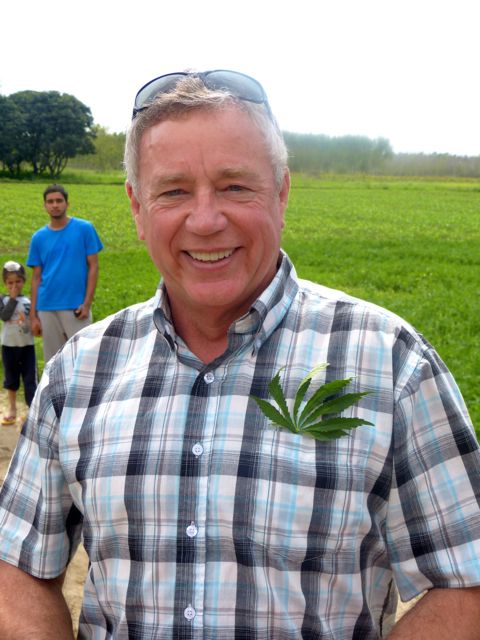
Marijuana grows everywhere.  If a crop is not in the ground, marijuana takes over.  The ditches are full.  It is not used for any purpose in this area.  Livestock and birds will not eat it but there are stories of non-Indian young people relocating to the area for months at a time to indulge themselves.  Food is cheap and weed is plentiful.

Marijuana, Wheat, Poplar


Marijuana, Cow patties, Stan


We arrived in Pajodatta and met more family and village neighbors.  Jinder’s cousin, Natha farms the area and keeps a country home as needed but spends most of his time in residence in Jullundher.  Natha is a successful farmer but also gives back to the village as a patron, supporting both the school and temple.

We walked to the village school established by Natha’s grandfather seventy years ago and visited the classrooms.  School was in session and our visit likely ruined the learning environment for the rest of the day.  The kids were excited and eager to show us their work.  The principal proudly had the best reader in the school read out loud in English for us.  The school housed preschool-aged kids up to children around eleven.  The curriculum is focused on Punjabi, Hindi, English languages and Mathematics.

Preschoolers and Their Lunch Pail


Boys Off To School


Three Principals Disturbing Class


Principal, George, Natha (Patron)


Staff and Preschoolers at Lunch


Our visit to Burrajatta was an emotional one for Jinder.  Much of his first seven years of life were spent in Burrajatta.  When we arrived in the village he began to reminisce about the yard he played in, the tree he played under, the lanes he walked and the house he slept in.  The village is very similar to when he left it.  As we stood on the roof he allowed himself think about what life might have been like had his father not made the decision to move. 

Jinder's Childhood Yard


Entrance to His House


His Courtyard Where He Ate and Played


 The house is still in his family and an outbuilding his great grandfather built still stands.  Their property is now let to local growers.  As we walked out to view his fields we passed a crew harvesting sugarcane and stopped to have a taste.  Workers put in long days for the equivalent of about $2.60 Canadian a day and three meals.

Girls In The Mustard Field


Off To The Fields


Sugarcane Harvest


Stan Could Not Resist Tryout As A Patty Packer


We returned to Pajodatta and Sukhvinder, Natha’s wife, and the ladies had our lunch prepared.  We had the most fabulous Indian meal and the fresh homegrown vegetables made it the best meal so far.

Everyday Cooking In The Village


Preparing Saug (Spinach Dish)


We returned to the hotel and some of us had naps while the others were out shopping the bazaar.  Deborah is now in the lead in the Pashmina count but Doreen has not capitulated as of yet.

We went to a restaurant/entertainment center called the Haveli.  We entered into a fully replicated farming village complete with life-sized recreations of every aspect of village life.  The meal was a traditional vegetarian meal representing Punjab of old.  We ate and drank some things we were unfamiliar with but so far so good.  Family (yes including us) pictures were taken and good nights were made with hugs all around.

Our New Jullundher Family

I experienced a truly senior moment when one of the young men shook my hand and then quickly bent and touched one hand to both my knees.  Kal explained later that that is a sign of respect for ones elders.  I guess the grey hair is proving some worth.

Off to Amritsar and the Golden Temple tomorrow.