Our first visit to Guanajuato was everything we
expected and more. Guanajuato (I
love saying the name out loud) has a bit of everything. It combines hundreds of years of
history with an active mining site and a vibrant academic/arts community. The city celebrates both visual and
performing arts, culminating in the Festival Internacional Cervantino which
includes artists and performers from around the world as well as Mexico.
 |
Theatre Juerez
|
The city traces its beginnings to the 1540s when the
Spanish discovered gold and silver in the hills surrounding the town. The town centre sits in a narrow
valley. The original miners dug
the minerals from the mountainsides but built the first-level ore extraction
buildings adjacent to the river.
The valley is so steep the streets (there are only two major ones) are
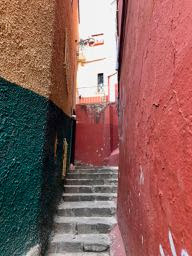
narrow, winding and room for only one-way traffic. Most alleys connecting neighbourhoods are too narrow for
cars and involve long sets of stairs to get up the mountainsides. According to our guide, there are 3200
alleys and stairways throughout the city. We witnessed workers carrying 50 kg.
sacks of powdered cement into the hills. As tour guide Gabriel mentioned, “There
are no chubby people living in Guanajuato”.

Unfortunately the original town centre sits below the
flood plain. The last devastating
flood occurred in 1905 when much of the town was underwater. Since that time the city has built
above the original buildings and as a result there are still underground walk
ways connecting different neighbourhoods.
Getting in, out, and around the city is so difficult,
the entire city is undermined with roadway tunnels to enable folks to move
about. Like many tourists, we
assumed the underground roads were remnants of old mining tunnels but no, it
makes an interesting story but the tunnels were not started until 1979 and the
last one was completed in 2008. There are 22 tunnels making up 14 kms of
underground roadways under the city.
There are approximately 250,000 folks living in the city in addition to
33,000 students attending the university.
 |
Cars Go In
|
 |
Cars Come Out
|
 |
You Find Women & Children Walking Alone - Very Safe
|
The journey to our hotel proved interesting. We flew from Mexico City to Guanajuato
but the plane actually landed in the nearby city of Leon. A 600 peso ride took us to the
city. Our taxi driver got lost in
the narrow streets and had to call for help. It was little wonder as the street markings were almost nonexistent
and our hotel was represented by a single wooden door to the street. Luckily it was on a street and not an
alley. No bag drag.
During the taxi trip we passed several huge automobile
assembly plants including GM, Honda, Toyota and Nissan. Later, I commented to Gabriel that I
had seen a lot of Asian folks in the town. His reply was, “far too many” suggesting that the arrival of
the management teams of the Japanese auto plants hasn’t been universally pleasing. He did admit that the relatively high
paying jobs were welcomed by the locals.
When pressed, he said the average unskilled (grade 12 graduates) workers
were earning about 200 pesos (less than $20 CDN per day), while skilled workers
(like in the auto plants) make closer to 800 pesos (less than $80 CDN) per
day. Practising professionals
might make as much as 1200 pesos. I
guess we know why car manufacturers moved their plants to Mexico.
After settling into our boutique Hotel Ponciano, we
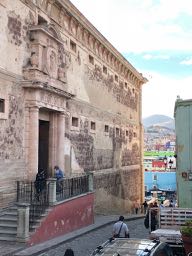
took a short stroll to the central zocalo. We passed the Guanajuato University’s downtown campus. The University Law School dominates the
skyline of the city. It is one of
the top schools in Mexico and is celebrating it 285th birthday. There
were street musicians, dancers and thespians entertaining the crowds in the
central square. It reminded us of
the vibrant squares in Italy where everyone comes to socialize and be
entertained in the evenings. One
of the Guanajuato traditions is to sign up with one of the 7 or 8 companies for
a show. The show involves
wandering the streets and alleys following a troop of musicians, stopping to
sing and perform skits. The
audience participates in everything from the singing, dancing and performances. Since the songs and jokes were in
Spanish, we (I) decided to give it a miss. The costumes were great.
 |
Zocalo Fountain
|
 |
Guanajuato Basillica - 50 M From our Hotel
|
 |
But I Don't Speak Spanish
|
 |
| From Our Hotel Room Window - G.U. |
Day two saw us explore on our own. The first stop was the Diego Rivera
Museum. Rivera is considered the
most famous artist in Mexico’s art history (1886-1957). He didn’t actually create his art in
Guanajuato but was born in the house that is now the museum. His sister gathered samples of his work
for display. Rivera is best known as
the Mexican leader in murals and one hangs in the upstairs courtyard.
 |
A Challenge To Find Initially
|
 |
Famous Mural
|
We visited the Contemporary Art Gallery.
 |
Luckily Nothing Was For Sale
|
We hired Gabriel Alcaraz on day two of our stay for a
four-hour tour. Gabriel’s English was
very good. I asked him where he learned the language and he told me he had
lived/worked in California for three years before being deported by Obama’s ICE
police.
 |
Pipila
|
Our first stop was the Alhondiga de Granaditas. The building dates back to the 1700’s and
served as the areas grain storage.
Most importantly, it was the scene of the first successful skirmish
between the Spanish and its Mexican born citizens. The Spanish blockaded themselves in the granary and managed
to hold off the rebels first attack until local miner, Juan Jose de los Reyes
Martines Amaro saved the day.
Nicknamed El Pipila, (apparently that translates into “turkey” since he
had the gait of a turkey from years of work in the mines). El Pipila hoisted a large, flat stone
onto his back and manoeuvred close to the granary door. With bullets pinging off the stone on
his back he managed to light the main wooden door on fire before fleeing. After the fire burned through the door,
the rebels stormed the granary killing all the Spanish soldiers and those loyal
to Spain. This action started the War of Independence
from Spain. El Pipila's statue sits
atop of the town and his name is still revered today.
 |
Tough Place to Attack - Pipila's Door
|
 |
| Add caption |
The next stop was the Mummy Museum. Essentially it is an underground walkway
viewing numerous dead bodies. The
simple notion of such a museum is repugnant to many gringos but Mexican culture
treats the notion of death differently.
Death is looked at as a natural process and the dead are revered as an
important remaining part of the family.
November 2 is the official Day of the Dead, when Mexicans present gifts
to those that have gone on before.
Even the national ski team competing in the South Korean Olympics have
bejewelled skulls adoring their uniforms.
Deborah was not comfortable taking pictures so the only one here is
copied from the Internet.

The mummies are not like those found in the tombs of
Egypt. There are no preservatives
or bandages on these. The mummies
of Guanajuato are simply dried remains of folks that died between 1860 and
1958. They were buried as they
were and appear to be only dried, not deteriorated. The clothing is mostly intact, down to their leather
shoes, The skin is dried and much
of their hair is still in place.
On some you can see the cause of death, like the discoloured skin near a
stab wound.

The mummy story has its beginning in 1860. Before then, folks with money could be
buried in a churchyard. In 1860 a
new law was created in Mexico guaranteeing all people a burial in a public cemetery
for a fee paid over the first four years after death by the family. Some folks didn’t pay. After four years, the bodies that had
families who didn’t pay, were dug up and their spots were given to paying
customers. In Guanajuato they
discovered that approximately two of every hundred bodies dug up, were still in
tack. Scientists say it is due to
that fact there is only 20 cm of earth in the area and bodies are not buried in
the earth. They are placed in wood
caskets in rock/concrete/brick tombs.
In the summer heat, the tombs act like ovens and the deceased body
fluids evaporate. They don’t speculate
why some and not all react this way.
Curiously the majority of those that do not deteriorate are women. No one knows why but guide Gabe suggested
that women are simply harder to get rid of.

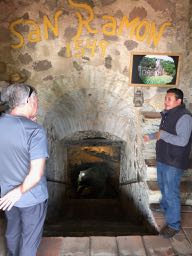
Our next stop was the San Ramon Mining Museum in the
hills above Guanajuato. The mine
was opened in 1548 and the museum does a good job of representing the
extracting of ore during early times.
Originally, indigenous people were used (slaves) to extract the ore in
exchange for food and a place to sleep.
Due to the lack of dust protection the miners usually lived to around 30
years of age. We took the steps to
the 60 meter mark and the return trip left us winded. It is hard to imagine the workers travelling deeper than
that and being required to carry 900 kg of raw ore to the surface everyday.
 |
Gabriel Telling the Mining Story
|
 |
A Vein of Silver
|
There is still an active mine in the immediate
area. It is owned by two Canadian
companies and they pay a royalty of 20% of the profits to the Mexican
government. Not a great deal for
Mexico but as Gabriel said, the Mexican government doesn’t have the funds to do
the mining themselves so this is the best deal they can make.
The fourth stop
was to the Hacienda San Gabriel de Barrera Museum. It was both a mining processing place and a residence for
the mine owner. It is now a museum.
The residence has been returned to its 17th century style and is surrounded by
gardens.
The last stop was
the lookout above the town. El
Pipila’s statue sits atop the cliff and the lookout offers outstanding views of
the old city.
Our last day was
spent visiting the Eulalios Ferrer Rodriguez Museum
that features a collection of Miguel Cervantes’ Don Quixote.
I confess, I have heard about Don
Quixote but have never read the book.
In fact, I didn’t know whether he was a fictional character in a book or
a real life person. Eulalois
Ferrer was a big fan and found the Cervantes’ book about the swashbuckling
Quixote such an inspiration he founded and dedicated a museum to the idea of
Quixote. I may have to read the
book for having been there.
 |
Ferrer's Original Copy - Received Upon Leaving Concentration Camp
|
We also spent some time eating, drinking and gazing over our visit.
 |
Truco7 Restaurant - Gabe's Referral
|
Off to Morelia by
bus to see the Monarch Butterflies.